Arrival at the Pyramids
You’ve probably heard about it before from other travelers – the high-pressure salesmen, the scammers, the crowds that pepper the site of the pyramids and Sphinx. What you’ve heard is true, but easily managed. On our way to the Giza pyramids, Ahmed warned us not to engage with the salesmen at the site. Don’t even acknowledge them. If they are persistent, only speak to tell them ‘no.’ Don’t touch anything they show you. Eyes forward, keep walking. Do not follow anyone anywhere. Stay within sight of the bus.
It was all a bit overwhelming, especially since it was the end of the day. We were all exhausted. At the site, we were one of a long line of buses. It seemed crowded, yet this was the “off” season – the HOT season. We were apparently very lucky for how few people were there.
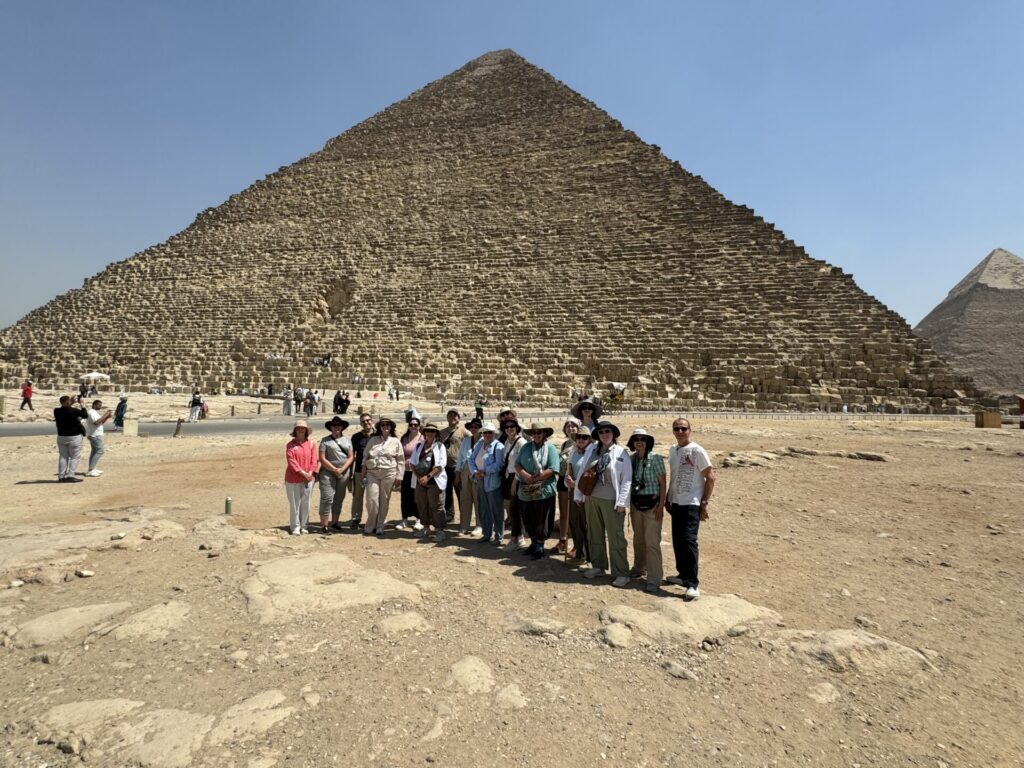
We started at the Pyramid of Khufu. It’s the largest of the three ancient structures. Behind it, we could see the beautiful pyramid of Khafre, Khufu’s son. Hidden from our perspective, was the pyramid of Menkaure, Khafre’s son, and The Sphinx.
The Great Pyramid
The Khufu pyramid is well-known as a “Wonder of the World.” It is big, enormous. A staggering feat of labor, it stands around 449 feet high. An estimated 2.3 million blocks towered above us. Yet, it’s shrinking. When it was built, it was probably around 30 feet higher. Along with loosing its outer facing limestone, which gave it a smoother look, many blocks have been “repurposed” for other needs over the millennia. Khufu was the son of Sneferu, the pharaoh responsible for the Bent Pyramid and Red Pyramid. Khufu’s builders benefitted from Sneferu’s mistakes. This pyramid is the uncontested Great Pyramid, largest and most famous of all pyramids across the entire globe. Built 4500 years ago, it still amazes 21st century visitors.
The main walk from the ticket office to the pyramid is a built wooden path, but it is full of salesmen. As you pass, they hold their wares in front of your face. You’re encouraged to touch, feel, and hold their trinkets and gifts. Ahmed had explained this was common practice. If you touch or hold something, they may accuse you of agreeing to purchase it and demand payment.
It was the end of the day. We were tired. They were tired. One particularly persistent salesman kept trying to hand me an Egyptian cotton scarf. I tried my best Arabic “no,” and he mocked me for my attempt. However, he did leave me alone. Later, I learned I hadn’t really needed to use Arabic; the vendors understand “no” in every language. We went on to take an uneven, rocky path to avoid the rest of them.
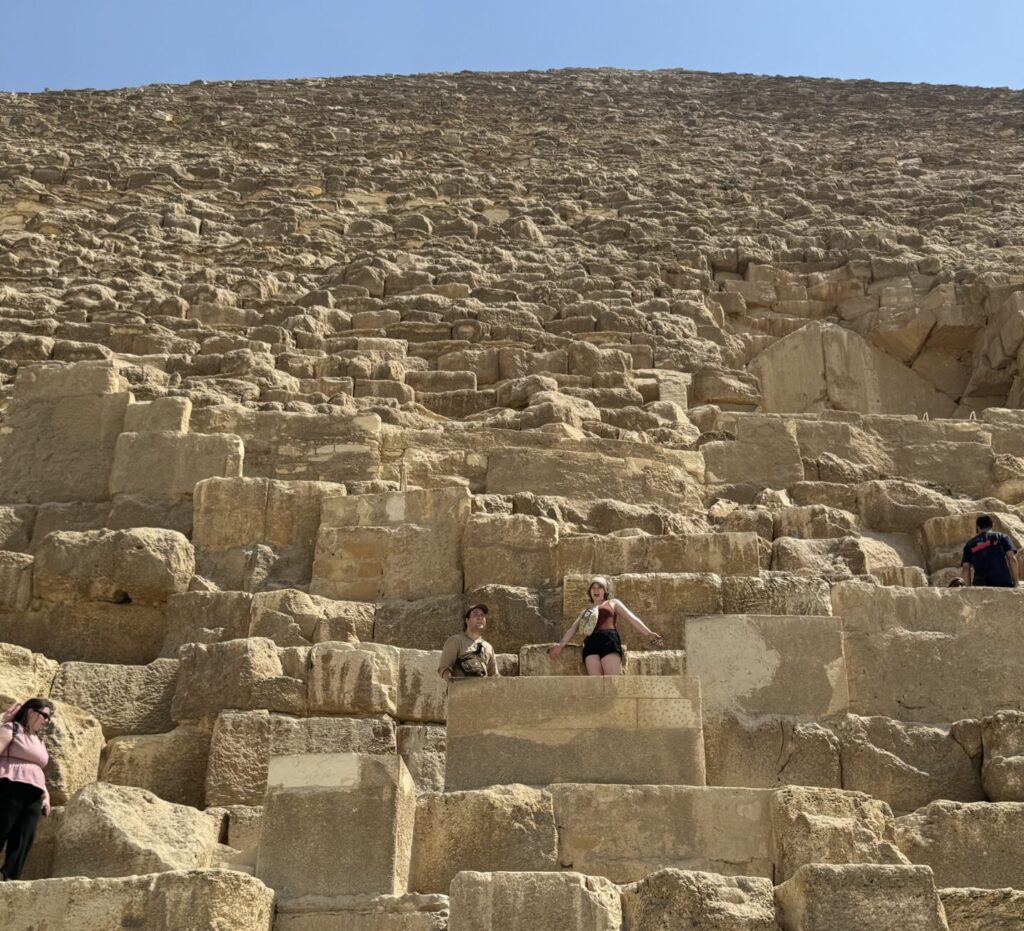
There is a small section of the pyramid of Khufu that you can climb up. A staircase follows the side up to an opening. Those who still had energy climbed up and we took pictures of them. I stayed on the ground. At the time, climbing another pyramid, even a short distance, did not seem worth it to me. The next day, I regretted it. But the thought of ascending the shadeless structure was just too much. Apparently, there is a gate at the top of the stairs. You could peek inside, but there wasn’t anything to see. We all tried to take photos that would reflect the scale of the monument, but it was impossible.
The Pyramid of Khafre
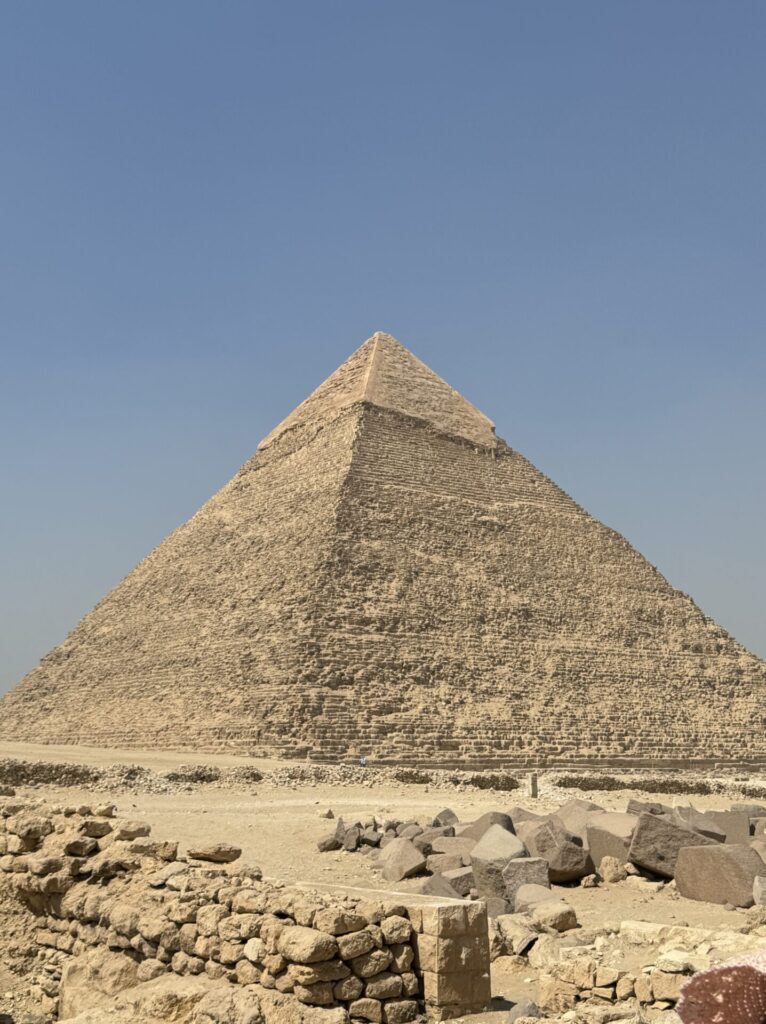
The Khafre pyramid was peeking from behind the Khufu pyramid. Ahmed went on to tell us about the history of the site. The Khafre pyramid is younger than its neighbor by one generation. Khafre was Khufu’s son, but not the expected heir. Historians don’t believe his older brother, Djedefre, lived long enough to succeed their father.
The Khafre pyramid still has some of the original limestone shell at the top. At one time, it covered all three pyramids. It gave them all a flawless look. In my opinion, Khafre’s pyramid was the most beautiful of the three.
The Pyramid of Menkaure
We got back on the bus and drove to the entrance of the pyramid of Menkaure. Of the three, it was the smallest, but we were able to explore it. After the Red Pyramid, the walk down the shaft didn’t seem like much of a challenge. Inside, it was humid, the walls were slick from breath and sweat. You could smell the tourists, so many had passed through every day that the prevalent odor was armpits. In the Red Pyramid, it was only decay and ammonia.
At the bottom were a couple of small, unadorned chambers. One had an arched roof, but nothing felt very exciting after our previous activities. Emerging out of the pyramid, we had a fantastic view of Khafre’s from across the plateau. For a few moments, I basked in their presence. This was the last pyramid we would visit during our trip. I was reluctant to leave, despite the exhaustion. But if you stand still for too long, the sellers start to crowd around. I gulped down nearly all my water and started back towards the bus.
Camel Rides
We headed to a nearby area which offered short camel rides across the sand. Here, you could take the quintessential Egyptian tourist photo: riding a camel across the dunes with the pyramids in the background. I was told all the camels had American names. There was Mickey Mouse, Elvis, even Rocky.
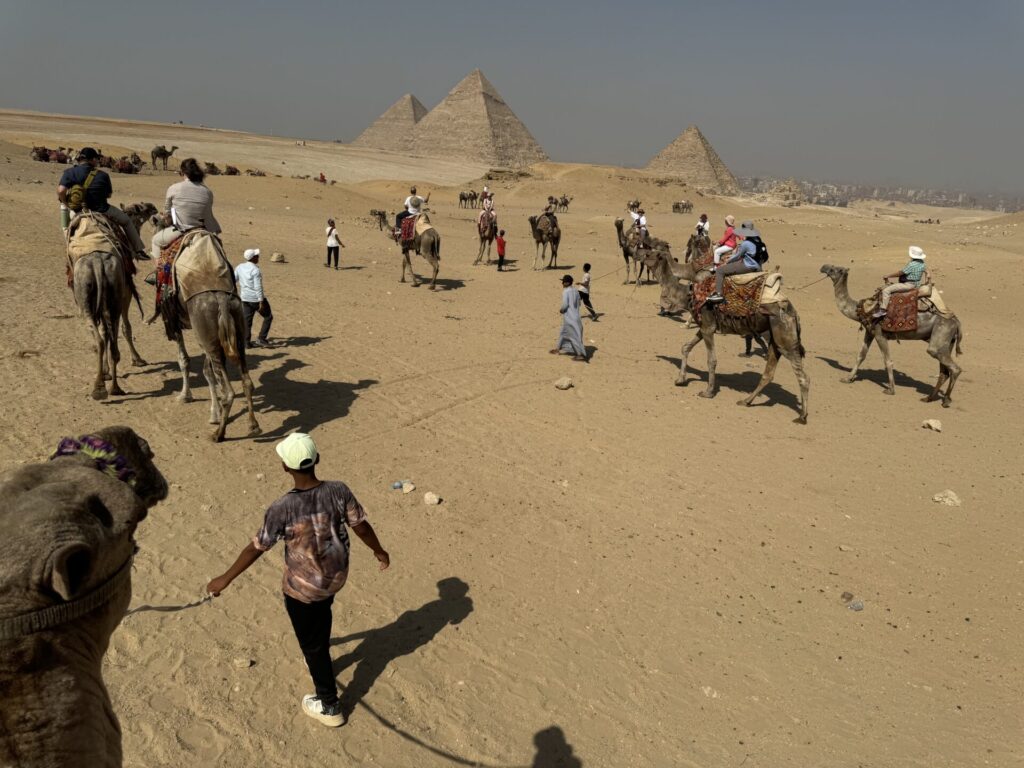
Yet, it should be mentioned, I’ve heard that German tourists are told the camels have German names, French tourists are told French names, so on and so forth. I, and a handful of other group members, elected to stay on the bus. Riding a camel was not an interest for me. I’d already ridden one at the state fair. It wasn’t an experience I was dying to repeat. Unlike the staircase of the Great Pyramid, I haven’t regretted this choice.
The Sphinx
After the riders returned to the bus, we took another short drive to the Sphinx. This was not what I expected, at all. I had heard how close the city has encroached upon the site.
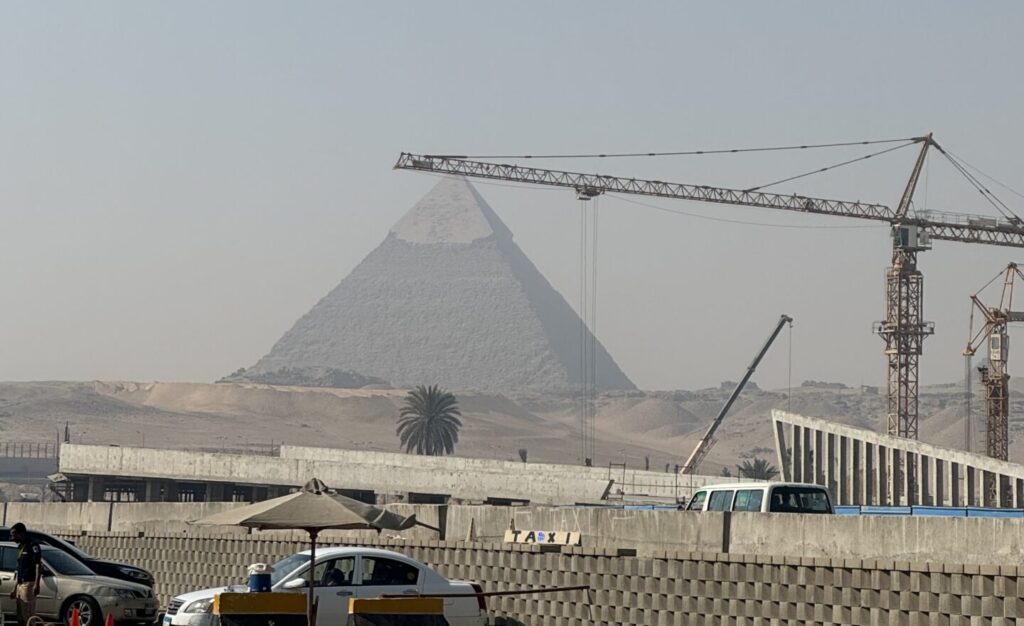
There’s even an infamous Pizza Hut within view. Yet, I still had romantic notions regarding the enigmatic sculpture. We walked through a crowd of more sellers and along an old canal that’s being excavated. You can see part of its path. It seems to run in the direction of the Sphinx. Ahmed explained it was recently discovered, and Egyptologists now believe the blocks used to build the pyramids were carried to the site by rafts in the canal. It stops, apparently, right at the front paws of the Sphinx.
Shortly after this, we finally got a good look at the Sphinx – from behind a gate and walls. It was not accessible to the public to get closer. From where we stood, we could just see its head and shoulders.
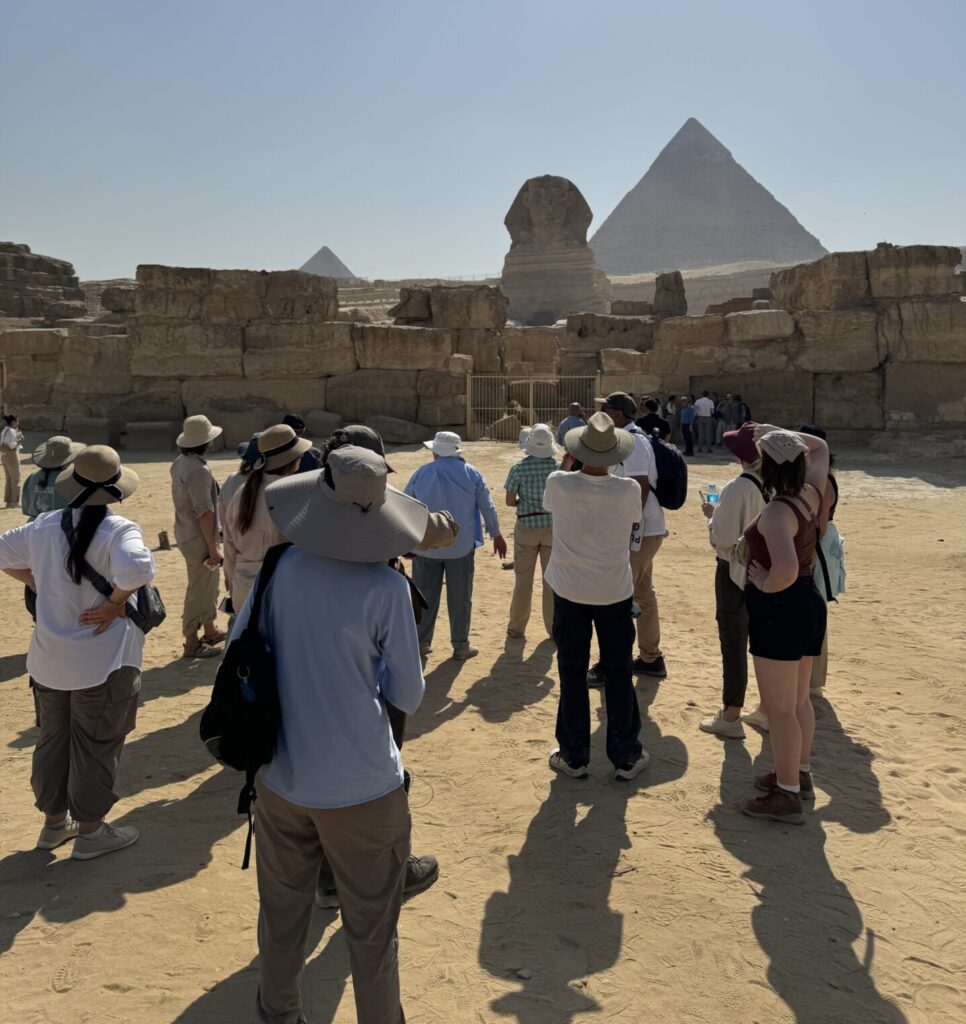
No one is sure which pharaoh is responsible for the Sphinx, but a popular theory is Khafre may have commissioned it. The statue aligns so well with his pyramid complex. It might have served as an entry for ancient worshippers, as it was also next to his valley temple. Others say that Khufu is responsible for the Sphinx, and his son simply added on to it. Hopefully, further excavation will one day reveal the answer.
We had arrived at the Sphinx as the park was closing. The site guards hassled Ahmed to move us along. A special event was planned for the night, with what looked like a stage, spotlights, and a DJ booth. We took some quick photos after Ahmed’s lesson and walked back to the bus. And yes, almost directly opposite the Sphinx is a bright, colorful, Pizza Hut. One need only cross the street.