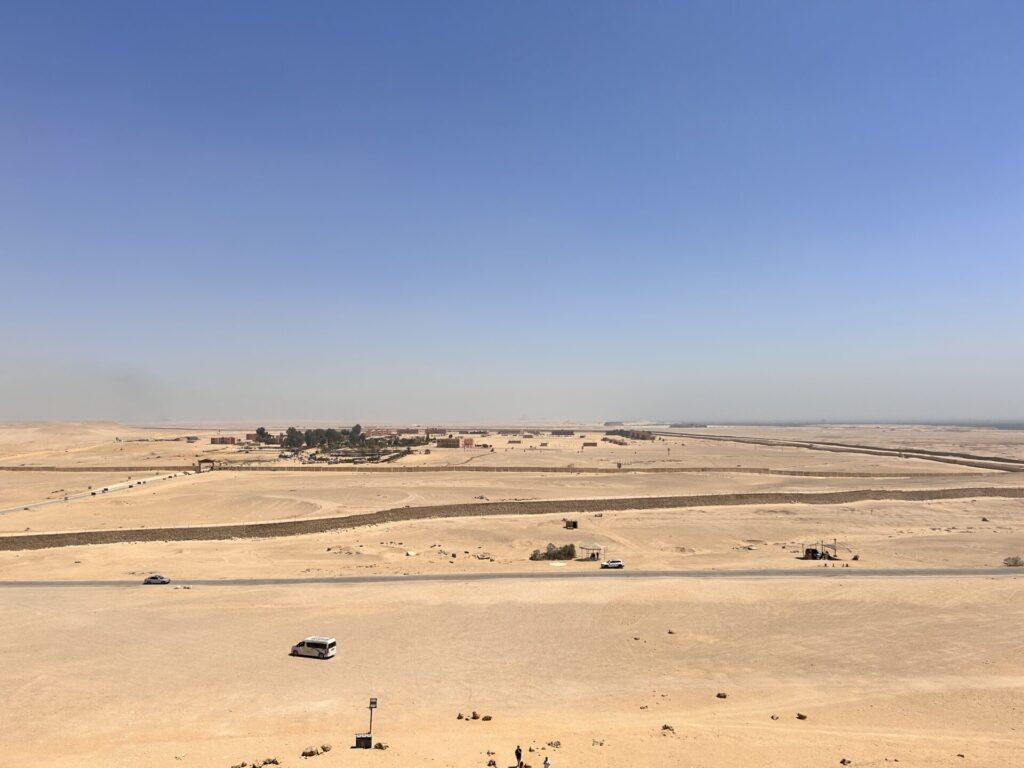
The Sakkara Funerary Complex is known for the Step Pyramid of Djoser. Yet there are many more funerary sites spread across the area – many of them non-human! Included in these sites are catacombs of dogs, cats, baboons, and even hawks.
As we left the Pyramid of Unas, we loaded back onto our bus. The north side of the complex held the Serapeum, Catacomb of the Sacred Apis Bulls. I wasn’t sure what to expect; my memory had failed me on the details of this site. The term “Serapeum” was ringing a bell, but I couldn’t quite remember the significance. As we stepped out of the air conditioned bus, the blast of heat as we stepped down onto the sand felt more oppressive than before. The sun had grown much hotter than when we started that morning.
The Cult of Apis
The Cult of Apis was popular and long-lived in ancient Egypt. Actually alive, the Apis Bull was chosen each generation. It was considered the embodiment of Ptah, a god of creation and crafts. The bull’s movements and behaviors were interpreted as prophetic. Generally, the bulls lived long, happy lives. In the Late Period, their deaths even occasioned national mourning periods. After its death, the bull became the embodiment of Osiris, god of death, resurrection, and fertility. The Serapeum Catacomb was the final resting place for many of the beloved Apis Bulls.

The cult may have begun as early as the Pre-Dynastic Period of Egypt. The beliefs continued through the Ptolemaic Period. Later, the Romans even adopted Apis, named Serapis, into their own pantheon. Despite the long history of the cult of Apis, the Serapeum was a newer addition to Sakkara, although still ancient by our standards. Having been commissioned during the New Kingdom, it gained popularity through the Late and Ptolemaic Periods.
Into the Catacombs
Once we descended into the catacombs, Ahmed, our official guide, gave us a brief history of the site. Soon, we were on our own to explore.

After Ahmed’s brief lesson, I expected to see the burials of the Apis Bulls. However, what I did not expect was the sheer, monumental scale of their sarcophagi. A bull is a big animal, of course, but their granite sarcophagi are huge. It was shocking. With lids, they average about 60 tons. Parking an SUV inside the coffins looked like an easy feat. They were so large, it took 28 days of work for the ancient Egyptians to move a sarcophagus into the Serapeum Catacomb.

Walking down the main corridor, my mouth hung open. Awestruck, I couldn’t imagine the labor it took. When the Serapeum was excavated in the 19th century, French archaeologist Auguste Mariette found evidence of rollers and rails along the floor, along with winches at strategic points. These simple machines would help move the sarcophagi smoothly. Yet, it wasn’t a perfect operation. Some of the sarcophagi didn’t make it all the way to their resting places. Seemingly unfinished, an immense granite coffin laid in the middle of one of the corridors. Abandoned for millennia, it appeared to be too dang heavy.
Not far from the abandoned sarcophagus, we passed through a small chamber. Along the walls were many small niches. The living would come into this space to pray and make offerings.

Lost to History
The Serapeum Catacombs were left behind, ignored, during the Roman Period. The Cult of Apis continued in the area, but they stopped burying their bulls in the complex. Later on, looters broke into the catacombs. They stole the riches entombed with the bulls, likely during the Christian Era. When Mariette rediscovered the site, only a couple sarcophagi were undisturbed.
When we descended into the depths, I wasn’t prepared to be so impressed. However, the Serapeum shocked me with its scale. There were so many ways the Egyptians could have memorialized the bulls. They could have continued to create individual, unconnected tombs. Yet, they dug a long, underground corridor with mechanisms to drag huge, granite sarcophagi that were nearly the width of the passage. The time, money, and effort they spent to honor the bulls was nothing short of incredible. To think, some Egyptian pharaohs didn’t even receive such opulent burials.
The Dahshur Pyramids
Once again, we climbed back onto our bus. The cushioned seats and crisp air conditioning felt luxurious. In a few minutes, we would visit Dahshur. This necropolis is famous for the Bent and Red Pyramids. Considered to be an ancient mistake, The Bent Pyramid was intended to be the resting place of Sneferu, a pharaoh of the Fourth Dynasty (roughly 2600 to 2500 BCE).
Sneferu’s Demands
The Bent Pyramid was supposed to be very tall, with a 54 degree incline. For reference, the popular Great Pyramid of Giza is slightly less steep, with only a 51.5 degree incline. The Bent Pyramid was too ambitious. Realizing it would collapse in on itself, the builders amended the angle halfway through. Therefore, its referred to as “bent” or “blunted,” because the top section turns into a 43 degree incline.
Generally, it’s believed that Sneferu was never laid to rest inside. Unhappy to see the modified angle of the Bent Pyramid, he demanded a new one with a smooth slope. Therefore, the construction of the Red Pyramid begun.

It was destined to be Sneferu’s actual resting place. It was built of red limestone with an angle of about 43 degrees, the same as the top portion of the Bent Pyramid. Apparently, they decided to play it safe rather than sorry.
The Red Pyramid
We weren’t able to go inside the Bent Pyramid, but we could with the Red Pyramid.
But, it would not be an easily accessible entrance. First, we had climb about halfway up the outside of the pyramid, and then descend into it via a long, steep tunnel. To reach the Inner Chamber, we would climb another two to three stories. Then, of course, would be the return journey.
I was not feeling hopeful. Only our first day in Egypt, we had already traveled, walked, climbed, and seen so much. Yet, it was not even lunchtime yet! On top of that, I was exhausted from the heat, dehydration, and jetlag. All I wanted to do was lay down for a nap. I thought I had trained well for Egypt. Taking long walks in the Iowan heat and stairs at work (when I felt like it) had apparently not been enough. I could have spent endless hours on the Stairmaster and still not have been prepared for this.

I wasn’t alone in my caution. But, we dragged ourselves out of our seats and walked across the sandy plain under the harsh sun. Up the side of the pyramid, the steps were uneven from years of wear. Eventually, there was a rail to hold onto. We took frequent breaks on small landings. At the top of the stairs, an unofficial guide was stationed along with an awning and benches to rest. We looked across the sandy vista. Peeking up along the horizon, we could see the Step Pyramid from earlier in the day.
After a few minutes of catching our breath, we prepared for our descent. Our group split into those who would go on and those who would stay behind. I decided to go for it.
The Descent into the Pyramid
Onnica explained the best way to proceed was to go backend first, as if descending a ladder. Inside, there were not proper stairs. There was only a wooden floor with railings to grab onto. The wooden planks formed a long ramp with perpendicular planks raised every few feet to provide foot holds.

If you fell, you would bounce all 200 feet down, with little to stop you except other visitors. The passage is only about 3 feet tall, so you have to stoop as you go. To look down, you have to turn and peek over your shoulder – not recommended. We went down blind.
Our group worked together as we moved down the passage. Shouting up, we alerted each other when the ceiling height changed or if there was a slippery section. Each person had eyes on the person above them. If one fell, there would be a domino effect. So, we took our time.
Now, if you’re thinking “at least they were out of the sun,” – I have news for you! Inside, the air was no relief. Yes, the sun was not beating down, but it was like stepping inside an oven. Everything was close and concentrated. There was a metal duct running down the side of the “stairs” in an attempt to pull fresh air into the suffocating heat and stink of the interior chamber. But, it didn’t seem to have much effect. The descent seemed to go on and on.
Reaching the Bottom
It was a relief to hit flat ground, albeit with shaking legs. My sweat mixed with sunscreen and dust; it ran into my eyes. We moved through a couple of chambers, but I don’t remember much about them. I was recuperating and drinking water. We came to a taller chamber with a wooden staircase. Rising up the wall, it met an opening that would be nearly impossible to reach otherwise.
A certain scent became more and more pervasive as we climbed the wooden stairs. It was becoming more difficult to breath. We went slowly, leaning heavily on the rails. There was another unofficial guide at the top of the stairs who guided us down a short path to another chamber. He warned us it would be very stinky.
Since not all of us would fit inside, we took turns. I waited and attempted to catch my breath. As others in our group took a few steps forward into the chamber, they immediately began gagging. It already smelled pretty bad, I couldn’t imagine it being much worse inside. Everyone took only a few steps in before taking a quick photo and immediately turning around to leave.
The Inner Chamber
Someone said, “Just a bunch of rocks and bats.” Oh. Soon, it was my turn. I walked forward, edging along the narrow tunnel. The smell was definitely getting worse. Another passed me on their way out, coughing, “See if you can hold your breath.” It was like a wall of heavy, thick ammonia. I closed my mouth and tried not to inhale. I looked up the 50 foot corbelled ceiling.

The pyramid stone was stacked neatly. I didn’t want to think of how many tons of rock was being held over me. Looking over a railing, we saw tumbled rocks at the bottom. I took a breath and immediately regretted it.
After snapping a couple blurry photos, I exited the chamber. I took a deep breath of air. It felt so much fresher than it had, only a few minutes before. I didn’t seen any bats, but the chamber was dark and I wasn’t wearing my glasses. But, by smell alone, I knew they were in there. I had read of bat guano (feces, for the uninitiated) being compared to ammonia, but I had never experienced it before. Since returning, I learned the scent only gets stronger with decay. I’m not sure how many years bats lived inside the chamber. Based on smell alone, they’ve been there since the pharaoh himself.
Climbing Back
Breathing as deeply as I could, I tried not to think about the climb back up to the entrance. We walked through the initial chambers. As we retraced our steps, we exchanged comments with other tourists.
Then, the ascent began. The climb seemed interminable. A few times, I thought I wouldn’t be able to make it. But, there wasn’t anywhere to rest or step aside for others to pass. Once you started, you had to finish. We took our time and patiently waited as people in front of us needed to stop for breath. Soon, we would be the ones needing respite.
Fresh Air
Looking back, I feel proud of myself to have made it. I’m not athletic and my twenties are far behind me. The whole way, I was huffing and puffing. When the sunlight became visible, I felt faint. My hands were numb and my legs were jelly. Had the air gotten even more stuffy since our descent? Yet, eventually, I was able to poke my head out of that pyramid. I took a big, triumphantly deep breath. Recounting the trip, I told my friends it might have been one of the most physically challenging things I have ever done.
We waited for the rest of the group to finish the climb. Looking out over the site, I was enjoying the occasional breeze. We joked around with the guide at the entrance. He was helping everyone onto the ledge when they emerged from the passage. Glowing with sweat and excitement, we thought about our first pyramid climb in Egypt!
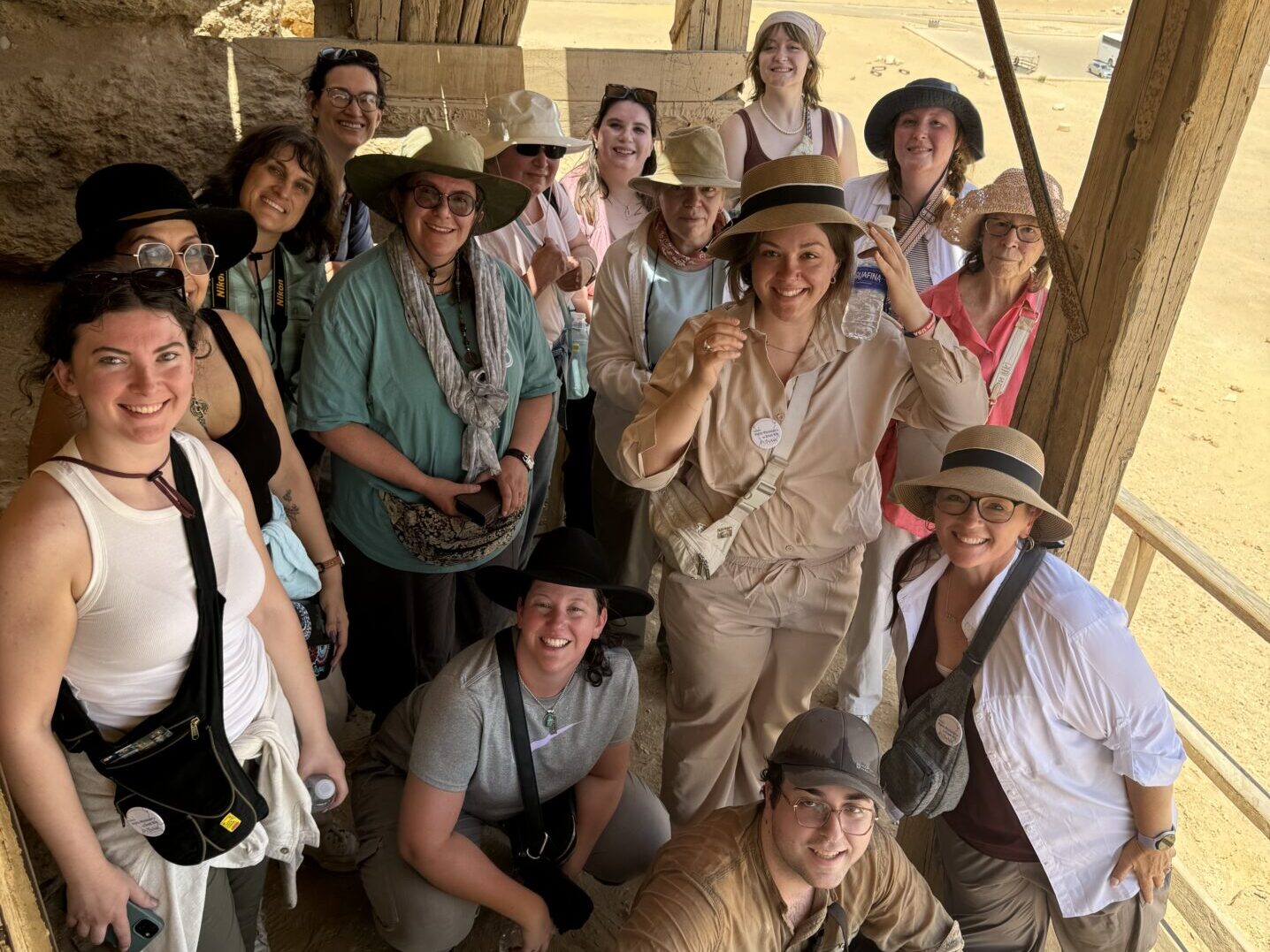
If I could tell my teenage self that one day, I would do this, I don’t think she would have believed me.
We rested and gulped water laced with electrolytes on the that ledge. Looking at the rough staircase below, bus in the distance, we wondered, “Had it been so far away when we first approached?”